

This live blog is being updated from October 25 to November 4.
Thank you for reading our updates and highlights. Our International and Monetary Economics Network has been developing in an impressive way, and we would like to express our sincere thanks to our members as well as to all individuals and organizations who have supported us with donations. You can become a member using this form or by joining us on Substack as a paid subscriber. We are open to collaborations, and we support our network members in realizing high-quality projects. Through our channels, we now reach more than 75,000 subscribers and followers.
In our webinars and in-person events, members of the network or guests are invited to present. We welcome high-quality presentations by senior and junior economists from academic, finance, or policy-oriented backgrounds.
Webinar “Productivity and Inflation Dynamics”
Jenny Chan (Bank of England), joint work with Ludovica Ambrosino and Silvana Tenreyro, November 3, 16:00 – 17:00 CET.
REGISTRATION HERE
LINK TO PAPER
Webinar “Demographic Change, Longer Working Lives and Economic Growth”
Siavash Mohades (Luiss Guido Carli & Mohades Research Consultancy), November 4, 16:00 – 17:00 CET.
REGISTRATION HERE
LINK TO PAPER
Webinar “On Inflation Dynamics: International Comovements, Nonlinearities, and Persistence”
Adnan Velic (Technological University Dublin), November 10, 16:00 – 17:00 CET.
REGISTRATION HERE
Webinar “Central Bank Balance Sheets and Financial Crises: New Historical Evidence from Advanced and Emerging Economies since 1900”
Pablo Aguilar (Centre d'Études Prospectives et d'Informations Internationales, CEPII), joint work with Eric Monnet, November 11, 16:00 – 17:00 CET.
REGISTRATION HERE
Webinar: The Economic Effects of Public R&D Funding: Evidence from 40 Years of US Contracts
Gianluca Pallante (University of Pisa), November 17, 16:00 – 17:00 CET
REGISTRATION HERE
Webinar “Industrial Policy and Trade Tensions in Strategic Sectors,”
Lorenzo Rotunno (IMF), November 19, 16:00 – 17:00 CET.
REGISTRATION HERE
“Holding Steady and Moving On: The ECB leaves interest rates unchanged as Lagarde announces early departure” by IMEN Fellow Emilie Vanderhulst.

No surprise!
The Fed holds interest rates steady despite persistently elevated inflation. The press release says that the "accumulation of more information will help the Committee determine the policy stance appropriate to ensure a timely return of inflation to the Committee's 2 percent goal. The Committee will deliver price stability."
In addition, the Federal Reserve plans to reduce the number of interest rate-setting meetings it holds annually.
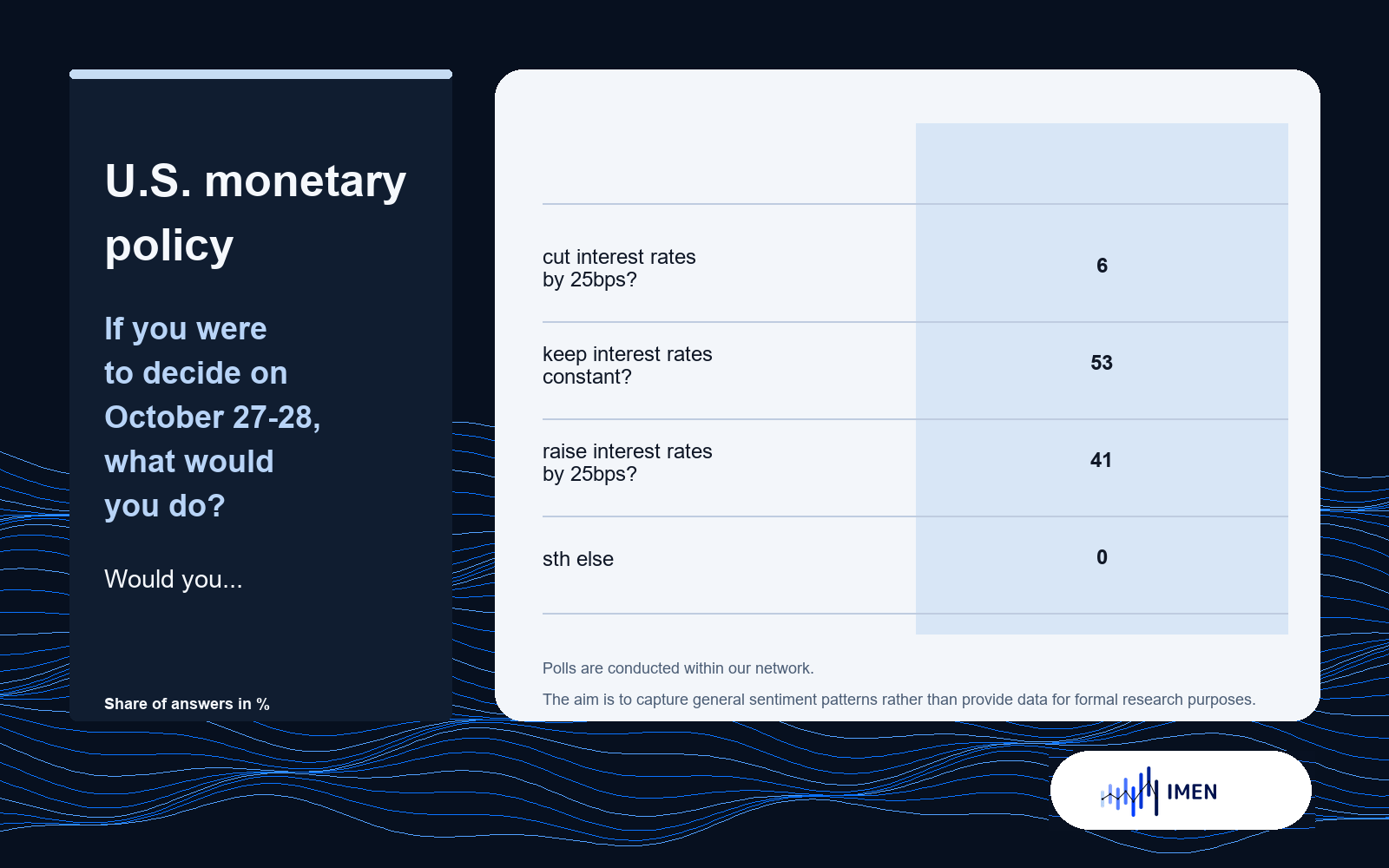
Most participants in our recent polls expected the Fed to keep interest rates unchanged in October (73 percent). We also asked the IMEN community how they would decide on monetary policy if they were policymakers. A considerable share would have raised rates (41 percent).
Our Global Economy Flash October 2026: The world economy has shown resilience, but the dampening effects of supply chain stress, geopolitical uncertainty, protectionism, and high public debt are considerable.
Highly relevant!
"Do People Have Economic Expectations?" by Peter Andre, Felix Chopra, Luca Michels, and Johannes Wohlfart.
"Expectations are central in economic models. But to what extent do individuals hold such expectations in the first place? We study whether — when thinking about an economic issue — individuals can build on previously-formed expectations. Many cannot: they must form expectations from scratch, even when close to making decisions for which the expectation should be relevant. This matters: individuals without previously-formed expectations (i) state more context-dependent expectations, (ii) update expectations more strongly but less persistently in response to new information, (iii) report expectations less relevant to decisions, and (iv) rely more on heuristics that do not require expectations when making decisions."
At IMEN, we independently select the events featured on our social media channels. However, we warmly encourage everyone to contact us with suggestions. Events may include, for instance, research- and policy‑oriented conferences, workshops, seminars, or panel discussions. You can use this form.
Below, you will find our other updates and highlights. By becoming an INEM member, you can help us further expand our activities – and enjoy special benefits. If you prefer not to join us on Substack as a paid member, membership is also available via this form.