

This live blog is being updated from October 18 to October 28.
Thank you for reading our updates and highlights. Our International and Monetary Economics Network has been developing in an impressive way, and we would like to express our sincere thanks to our members as well as to all individuals and organizations who have supported us with donations. You can become a member using this form or by joining us on Substack as a paid subscriber. We are open to collaborations, and we support our network members in realizing high-quality projects. Through our channels, we now reach more than 75,000 subscribers and followers.
In our webinars and in-person events, members of the network or guests are invited to present. We welcome high-quality presentations by senior and junior economists from academic, finance, or policy-oriented backgrounds.
Webinar “Critical Minerals, Geopolitics, and the Green Transition”
Jonathan Elliott (Johns Hopkins University), joint work with Tomás Domínguez-Iino and Allan Hsiao, October 29, 17:00 – 18:00 CET.
REGISTRATION HERE
LINK TO PAPER
Webinar “Productivity and Inflation Dynamics”
Jenny Chan (Bank of England), joint work with Ludovica Ambrosino and Silvana Tenreyro, November 3, 16:00 – 17:00 CET.
REGISTRATION HERE
LINK TO PAPER
Webinar “Demographic Change, Longer Working Lives and Economic Growth”
Siavash Mohades (Luiss Guido Carli & Mohades Research Consultancy), November 4, 16:00 – 17:00 CET.
REGISTRATION HERE
LINK TO PAPER
Webinar “On Inflation Dynamics: International Comovements, Nonlinearities, and Persistence”
Adnan Velic (Technological University Dublin), November 10, 16:00 – 17:00 CET.
REGISTRATION HERE
Webinar “Central Bank Balance Sheets and Financial Crises: New Historical Evidence from Advanced and Emerging Economies since 1900”
Pablo Aguilar (Centre d'Études Prospectives et d'Informations Internationales, CEPII), joint work with Eric Monnet, November 11, 16:00 – 17:00 CET.
REGISTRATION HERE
Webinar “Industrial Policy and Trade Tensions in Strategic Sectors,”
Lorenzo Rotunno (IMF), November 19, 16:00 – 17:00 CET.
REGISTRATION HERE
Very valuable!
"The Age of Geoeconomics: How the Logic of International Economics and Politics is Changing" by Mikael Wigell and Mohammed S. Hadi.
The Age of Geoeconomics "powerfully explains how market economics is being supplanted by geoeconomics. Geoeconomics refers to the way in which countries use economic tools—trade, investments, financial policies and penalties, such as tariffs and sanctions—to achieve political or strategic goals. Instead of using military power, countries compete and influence each other through economic means. The Age of Geoeconomics skilfully outlines ways in which governments may choose to impose trade restrictions such as tariffs to pressure other governments, invest in infrastructure projects to gain influence, or use control over key resources (like oil or rare minerals) as leverage in international negotiations. This very timely book assesses the re-shaping of the economic world-order following the US election, including an analysis of 'MAGAnomics'."
Olli Rehn (Governor at the Bank of Finland, Finland): "Purely market-based economic globalization is receding, replaced by geoeconomics as the defining logic of the current geopolitical era. The Age of Geoeconomics provides an indispensable analytical toolbox for understanding-and wielding-the economic statecraft shaping today's world."

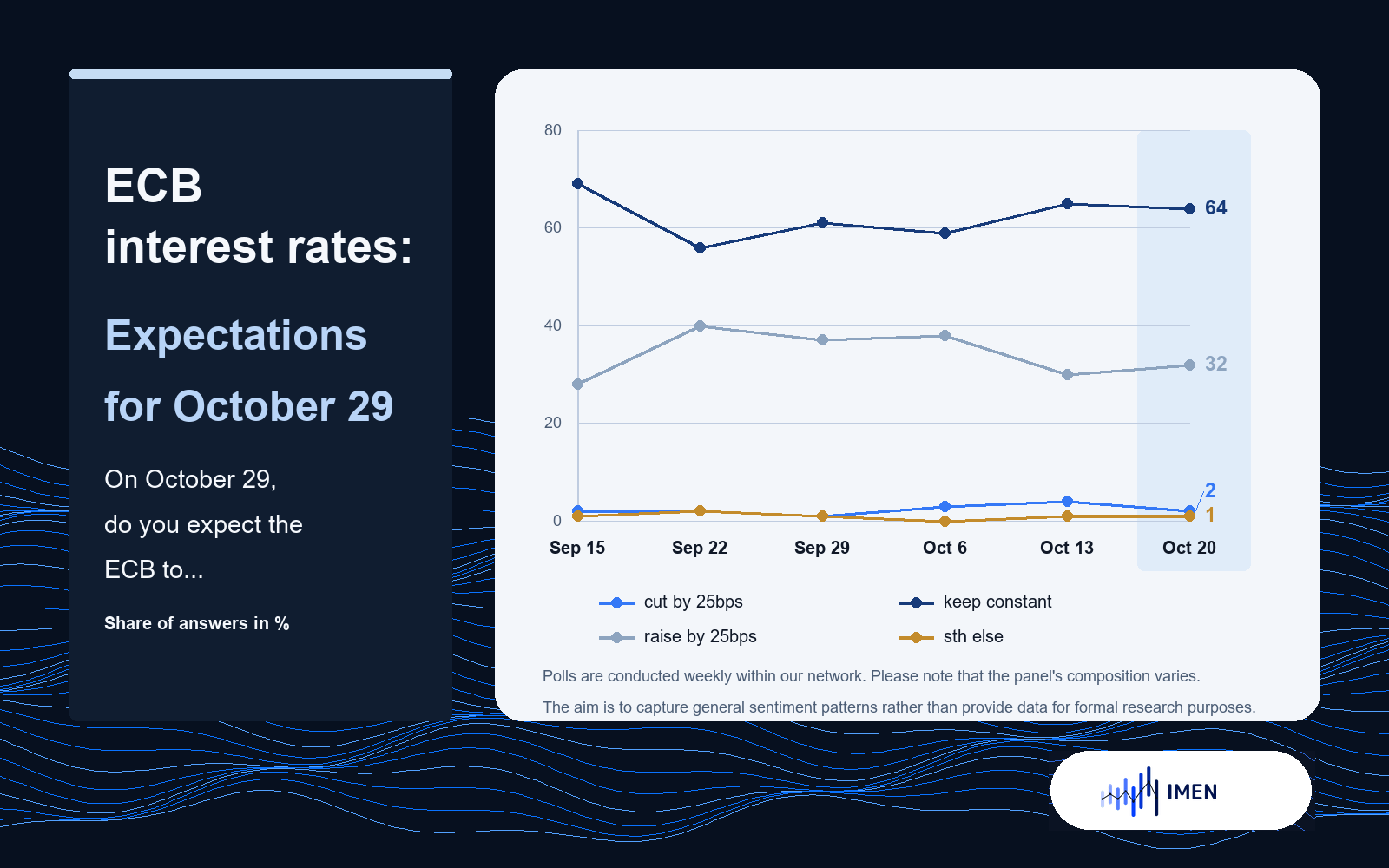
Most participants in our recent polls expect the ECB to keep interest rates unchanged on October 29.
US Economy Flash September 2026: Will the AI boom last?
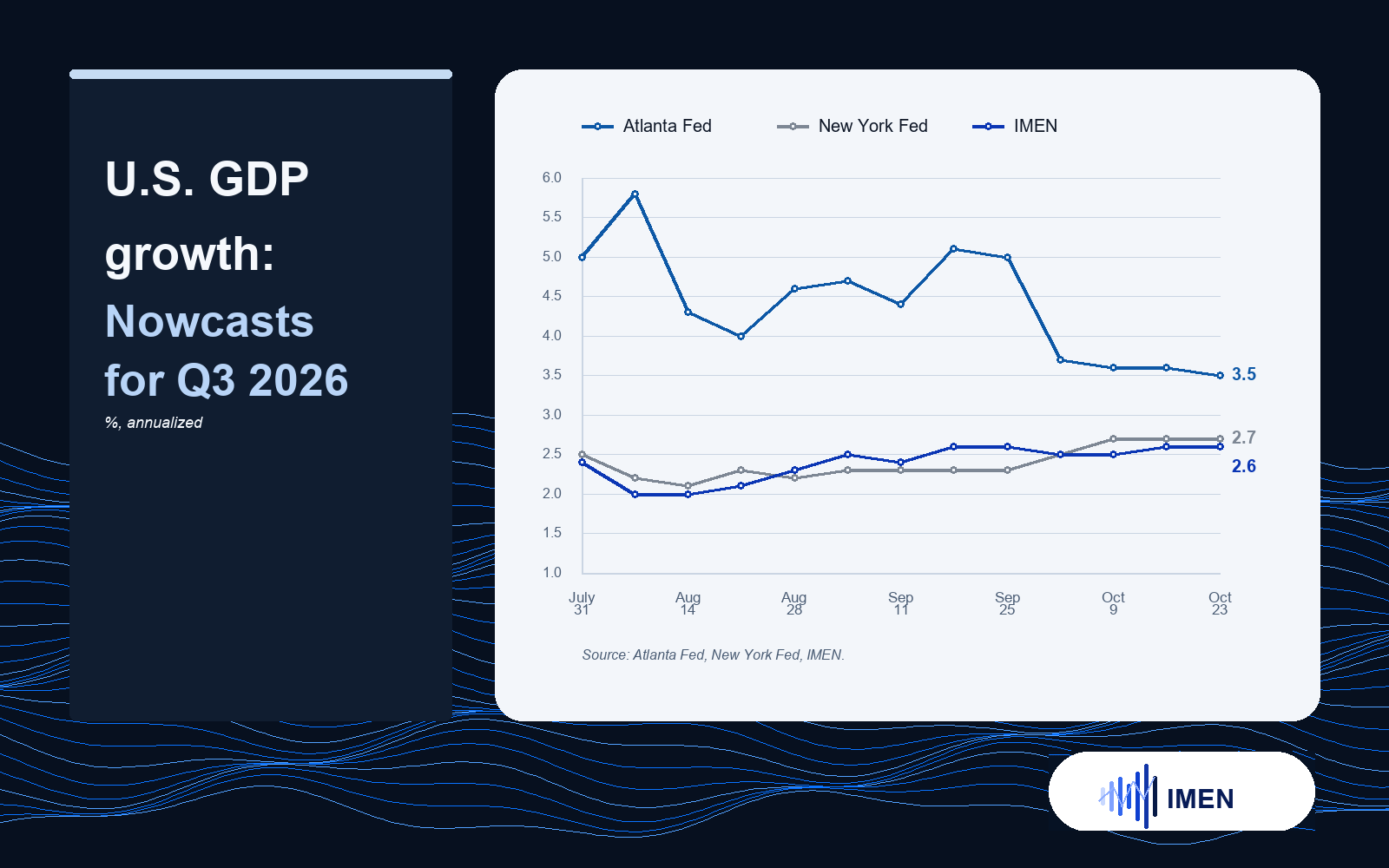
Nowcasts for U.S. GDP growth in the third quarter of 2026 currently indicate annualized growth rates between 2.6 and 3.5 percent. Although the economy is facing several headwinds, GDP growth is currently expected to remain solid.
Our Global Economy Flash October 2026: The world economy has shown resilience, but the dampening effects of supply chain stress, geopolitical uncertainty, protectionism, and high public debt are considerable.
Euro Area Economy Flash: October 2026 In the second quarter of 2026, GDP growth in the euro area was stronger than many observers had expected.
Super interesting!
"Saving for the Machines" by Jesús Fernández-Villaverde.
"When machines can perform a growing share of tasks, growth depends on two margins: how the task structure affects the returns to accumulating machines, and how strongly capital accumulation responds to those returns. I argue that, in a standard task model, capital supply governs the size of the growth boom associated with automation, while the task structure sets the duration of this growth boom and the evolution of wages. I document how the same technology path that generates 11.7% annual growth when households choose their saving rate optimally delivers only 2.2% when the saving rate is fixed at the calibrated U.S. 2025 level of 23%. Therefore, slow growth might reflect too little capital accumulation instead of a technological bottleneck. Also, the saving rate rises mainly because automation raises the capital share, not because households become thriftier. Long yields price the growth boom: the ten-year real yield jumps from 5.1% to 13.6% on impact. In my benchmark calibration, hand-to-mouth households lose the equivalent of two-fifths to two-thirds of their consumption, while keeping them on trend temporarily costs at most a fifth of GDP."
At IMEN, we independently select the events featured on our social media channels. However, we warmly encourage everyone to contact us with suggestions. Events may include, for instance, research- and policy‑oriented conferences, workshops, seminars, or panel discussions. You can use this form.
Below, you will find our other updates and highlights. By becoming an INEM member, you can help us further expand our activities – and enjoy special benefits. If you prefer not to join us on Substack as a paid member, membership is also available via this form.