

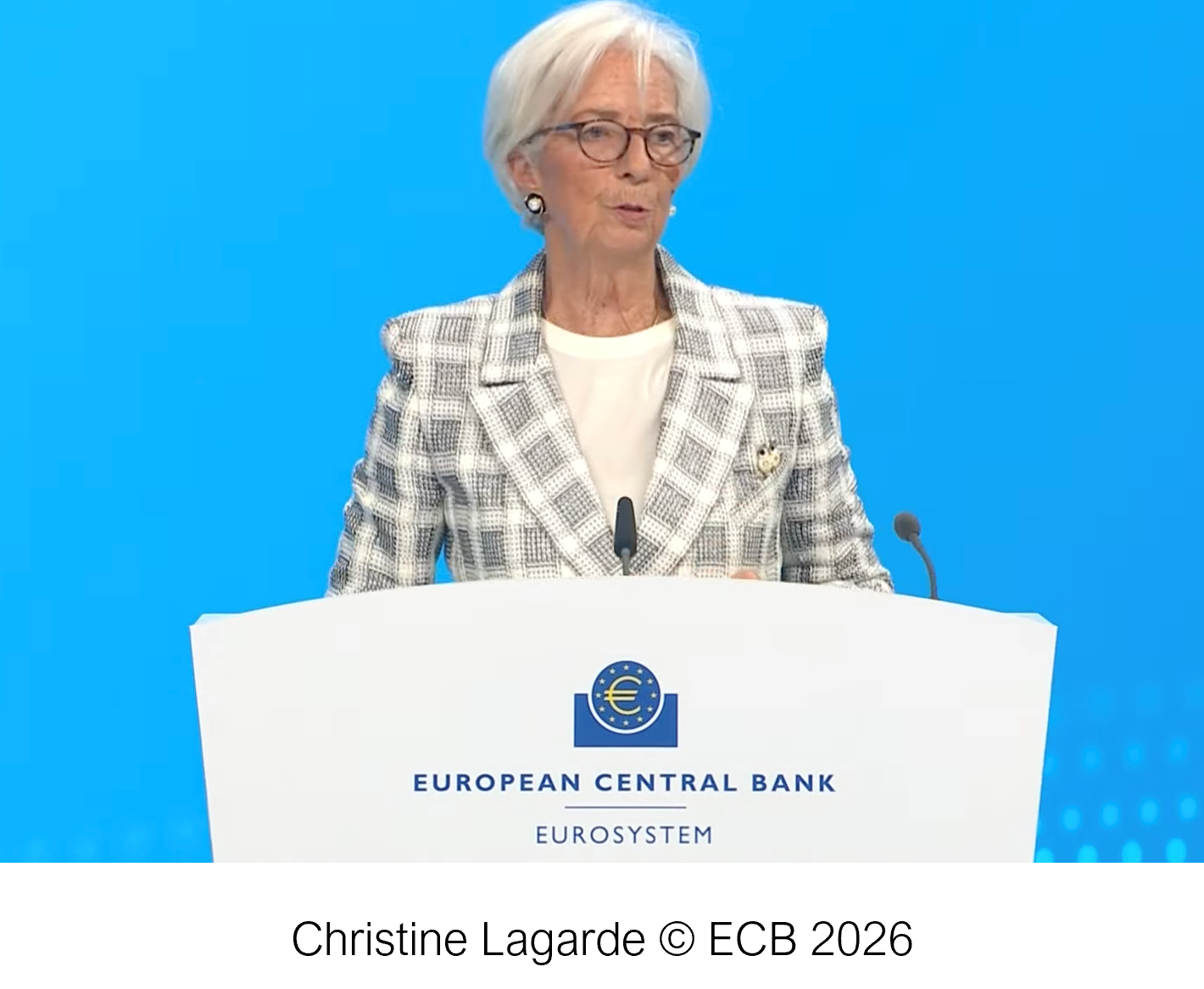
• Rates unchanged: ECB Governing Council unanimously paused rate hikes, as widely expected.
• Economic pressure: Context driven by surging energy prices and rising long-term financing costs.
• Future hikes: Markets and the IMEN network still anticipate a hike next meeting.
• Leadership Transition: Official morning confirmation that Christine Lagarde will step down early.
The ECB Governing Council unanimously decided to keep rates unchanged. This pause was expected. In a context marked by an increase in energy prices, markets still anticipate a rate hike at the next monetary policy meeting. This is also the outlook of the IMEN network. “Against the backdrop of elevated inflation, we pencil in a rate hike in December,” says IMEN Chief Economist Guido Baldi. “At the same time, second-round effects on wages seem to be limited. After one additional hike, we think that the ECB’s hiking cycle may come to a close.”
The main news of this meeting, however, was the announcement in the morning of Christine Lagarde’s early departure. President Lagarde will leave the ECB Presidency following the Governing Council’s monetary policy meeting on 7 February, eight months before the end date of her term as President.
Departures: Lagarde, Schnabel and Lane
Christine Lagarde’s term was due to expire on 31 October 2027. Speculation was already rife about a possible early departure and, following articles in the Financial Times, the Neue Zürcher Zeitung and Reuters, also about a new position at the head of the World Economic Forum (WEF).
President Christine Lagarde announced her early departure and explained her motivation in these words: “I will be leaving the European Central Bank in February 2027 because I want to have the freedom of speech, the freedom of expression, and the freedom to engage on matters that are not monetary policy matters.”
In particular, the President explained that at this stage she wished to be able to go beyond the neutrality required by her position and believed that her voice and her action could help in relation to principles dear to her, truth being among those principles. She specified that this concerned not only the European territory.
Following the announcement, António Costa, President of the European Council, stressed that the nomination process for the ECB presidency had already started. Kyriákos Pierrakákis, President of the Eurogroup, also stressed: “The Eurogroup will act swiftly to prepare the recommendation of the Council of the EU to the European Council on the appointment.”
The nomination process will be the same as for the succession of Ms Isabel Schnabel, which was announced on 24 September 2026 and will take effect on 3 January 2027. Isabel Schnabel will join the International Monetary Fund (IMF) as of 4 January 2027 as Financial Counsellor and Director of the Monetary and Capital Markets Department.
Philip Lane’s term as Chief Economist will also expire in 2027.
Nomination process for Executive Board members
The nomination process for members of the ECB’s Executive Board is enshrined in Article 283(2) of the Treaty on the Functioning of the EU: “The President, the Vice-President and the other members of the Executive Board shall be appointed by the European Council, acting by a qualified majority, from among persons of recognised standing and professional experience in monetary or banking matters, on a recommendation from the Council, after it has consulted the European Parliament and the Governing Council of the European Central Bank.”
Concretely, euro area Member States propose their candidates. They have to reach an agreement within the Eurogroup, the informal structure gathering ECOFIN ministers from the euro area. This step is then formalised by an official recommendation of the Council of the EU, usually at an ECOFIN meeting.
The European Parliament and the ECB Governing Council are formally consulted to provide their institutional opinions on the nominee’s professional suitability. Finally, the European Council has the final say: it makes the official appointment acting by a reinforced qualified majority vote of euro area member states, granting the individual a non-renewable, eight-year term.
Current frontrunners are Pablo Hernández de Cos of Spain and Klaas Knot of the Netherlands.
Klaas Knot is traditionally associated with a more hawkish stance, favouring stricter monetary policy to control inflation, while Pablo Hernández de Cos is viewed as more dovish, favouring a more accommodative approach.
Some voices, such as that of Positive Money Europe, have been heard regarding the composition of the future Executive Board. Positive Money Europe fears that the appointment of Klaas Knot may require the departure of the Dutch economist Frank Elderson, whose actions have been widely recognised as transformative in embedding climate and nature-related risk awareness both within the European Central Bank and across the broader eurozone banking sector.
Another concern, with the departure of Isabel Schnabel and Christine Lagarde, is ending up with a very male Governing Council. It should be noted that all the central bank governors are men.
October dovish decisions
Two key elements have changed since the September meeting, Christine Lagarde pointed out: on the one hand, energy prices continue to rise (up to 18.9% in September from 14.3% in August according to Eurostat) and are feeding overall inflation (according to Eurostat, the euro area annual inflation rate accelerated sharply to 3.8% in September 2026, climbing up from 3.2% in August). This is due to oil prices but above all to fuel oil, gas and refining margins.
The other new development is the cost of long-term financing. In this context, the Governing Council discussed the appropriateness of a rate hike, and the President moreover acknowledged that the meeting could have led to a rate hike. But the Governing Council ultimately opted unanimously to keep rates unchanged, owing partly to uncertainty and partly to measures of underlying inflation that have remained stable since the September meeting.
In addition, the ECB does not observe second-round effects on wages at this stage. The Governing Council considered in this context that it was in a position to wait for the next macroeconomic data.
Next meeting
“We decide meeting by meeting,” the President indicated, “but that does not indicate that we will not be hiking in December. Our next meeting is in December. If the assessment that we have today is not informed by significant developments, the direction of travel is clear,” indicated Ms Lagarde.
Forward guidance is not the ECB’s approach anymore; let us call it “framework guidance”. For the next meeting, on 16–17 December, Lagarde stressed that the Governing Council will indeed then have a new set of staff projections, two new inflation prints, GDP data, Q3 employment compensation per employee and negotiated wages, November PMIs, two runs of bank interest rate statistics, two employment readings, and industrial production data, “particularly relevant with regard to underlying inflation”.
Reaction function: attention paid to underlying inflation
Without prejudice to the examination of headline inflation and the dynamics of monetary policy transmission, “underlying inflation will probably take a particular standing in the three-prong that we apply in our monetary policy decisions.”
“The further we progress through the shock, the richer the underlying inflation indicators are,” President Lagarde added.
Growth still positive but slowing, financing conditions tightening
Referring to the risks weighing on the macroeconomic projections, President Christine Lagarde reiterated that risks to the euro zone’s growth outlook remain tilted to the downside. Moreover, referring to financing conditions, Christine Lagarde stressed that they have tightened further since the last meeting, which is expected to weigh on both growth and inflation.
This tightening is not solely related to the transmission of the ECB’s monetary policy. Faced with slowing economic growth prospects and the energy shock linked to the conflicts in the Middle East, banks are also being cautious and tightening their lending criteria. In addition, the rise in bond yields is pushing up the cost of credit for the economy as a whole. This combination acts as a restrictive drag on the eurozone economy.
In the euro area, real GDP growth slowed somewhat in the third quarter to 0.4 percent. However, this was higher than expected, further supporting the case for a rate hike in December. At the same time, the three largest economies in the euro area (Germany, France, and Italy) expanded at below-average rates, or even stagnated or contracted. Guido Baldi points out that “the subdued economic performance of the three largest economies in the euro area is a cause for concern and may also complicate the conduct of monetary policy.”